
Step 1
1
Assess
Plant-safe OT assessment of BAS/BMS, HVAC, refrigeration, and field protocols — without disrupting operations.
Home / Industries / Building Automation Systems
Building Automation Systems · BAS/BMS · HVAC · Retail Refrigeration · Building Controls OT
Grocery and retail, cold storage, data centers, hospitals, campuses, and commercial real estate all run building automation system cybersecurity risk on the same class of systems: BAS/BMS, HVAC, retail refrigeration, instrument air, and the vendor remote access paths that connect them. Red Tiger Security runs a plant-safe facility OT assessment of those live systems without shutting the site down. Then the team fixes what is hurting operations now. If you want Red Tiger to stay, a small OT firewall and network sensor go in at the site, the team watches those assets 24x7 with the Red Tiger SOC, and you get OT managed security services (MSP) + Metrics and Reports.
Three steps: assess the live building OT, harden it with a per-site OT firewall and network sensor, then watch it 24x7 with the Red Tiger SOC under OT managed security services (MSP).
Plant-safe OT assessment of BAS/BMS, HVAC, refrigeration, and field protocols — without disrupting operations.
Fix the immediate need: remove internet exposure, control vendor remote access, and add a per-site OT firewall and network sensor.
24x7 SOC with OT MSP + Metrics and Reports — alerts on logins, setpoints, and defrost changes.
OT security for commercial buildings across grocery and retail, cold storage, data centers, hospitals, campuses, and commercial real estate — plus the HVAC and refrigeration contractors who maintain them.
| Sector | What building OT usually includes |
|---|---|
| Grocery and retail | Retail refrigeration cybersecurity, display cases, walk-ins, HVAC, BAS/BMS head-end, vendor remote access |
| Cold storage | Freezer and cooler controllers, leak detection, refrigeration racks, contractor remote maintenance |
| Data center | CRAC/CRAH, chiller plant, generator and UPS monitoring, building controls OT security at the facility edge |
| Hospital | HVAC cybersecurity for patient areas, medical gas interfaces where present, life safety systems, BAS |
| Campus and commercial real estate | Smart building cybersecurity, multi-building BMS, boiler and chiller controls, access control and CCTV security |
The Europe freezer campaign is not just a European story. The same controller families and remote-maintenance model show up in U.S. stores and cold chain sites. On Nov. 5, 2026, CISA, the FBI, HHS, USDA, and DOT published a joint fact sheet on U.S. refrigeration and cold chain risk. [2]
According to Dark Reading's Nov. 6, 2026 reporting, the Oct. 11 incident caused millions of euros in damage across roughly 700 affected stores in France alone: spoiled food, damaged equipment, and some reported fires. The technology included Danfoss refrigeration controllers and Dixell and Copeland XWEB systems. How the attacker first got in has not been publicly confirmed. What is clear is the exposure pattern: internet-accessible web servers, default login credentials, and legacy products that no longer receive updates. [1]
Read Red Tiger's related advisory: U.S. refrigeration and cold chain joint fact sheet.
Operational technology (OT) in a building is the controllers and networks that run refrigeration, heating, ventilation, and air conditioning (HVAC), lighting, energy meters, and generators. Building automation systems (BAS/BMS) commonly integrate or interface with fire and gas detection, CCTV, and badge access control, along with elevators and other life-safety links. A wrong command here changes temperature, airflow, door state, or alarm response. The result is physical: spoiled product, an overheated control room, or a comfort and safety problem for people on site.
Information technology (IT) runs email, point of sale, corporate apps, and office Wi-Fi. IT failures hurt data and uptime. Building OT failures hurt the process the building is there to support. Many sites still treat BAS and refrigeration as facilities problems, not as OT that needs the same care as a plant control network.
Across grocery, cold storage, CRE, campuses, and mixed-use sites, OT shows up on the roof, mechanical room, utility entrance, sales floor, refrigeration, and site—plus remote/cloud paths. Fire/gas, CCTV, and badge access usually sit under building automation via the BAS/BMS head-end. The diagram maps a typical facility; open a group for each system.
Many of these systems are also IoT/IIoT: smart thermostats, wireless sensors, cameras, and cloud-connected controllers — in scope too.
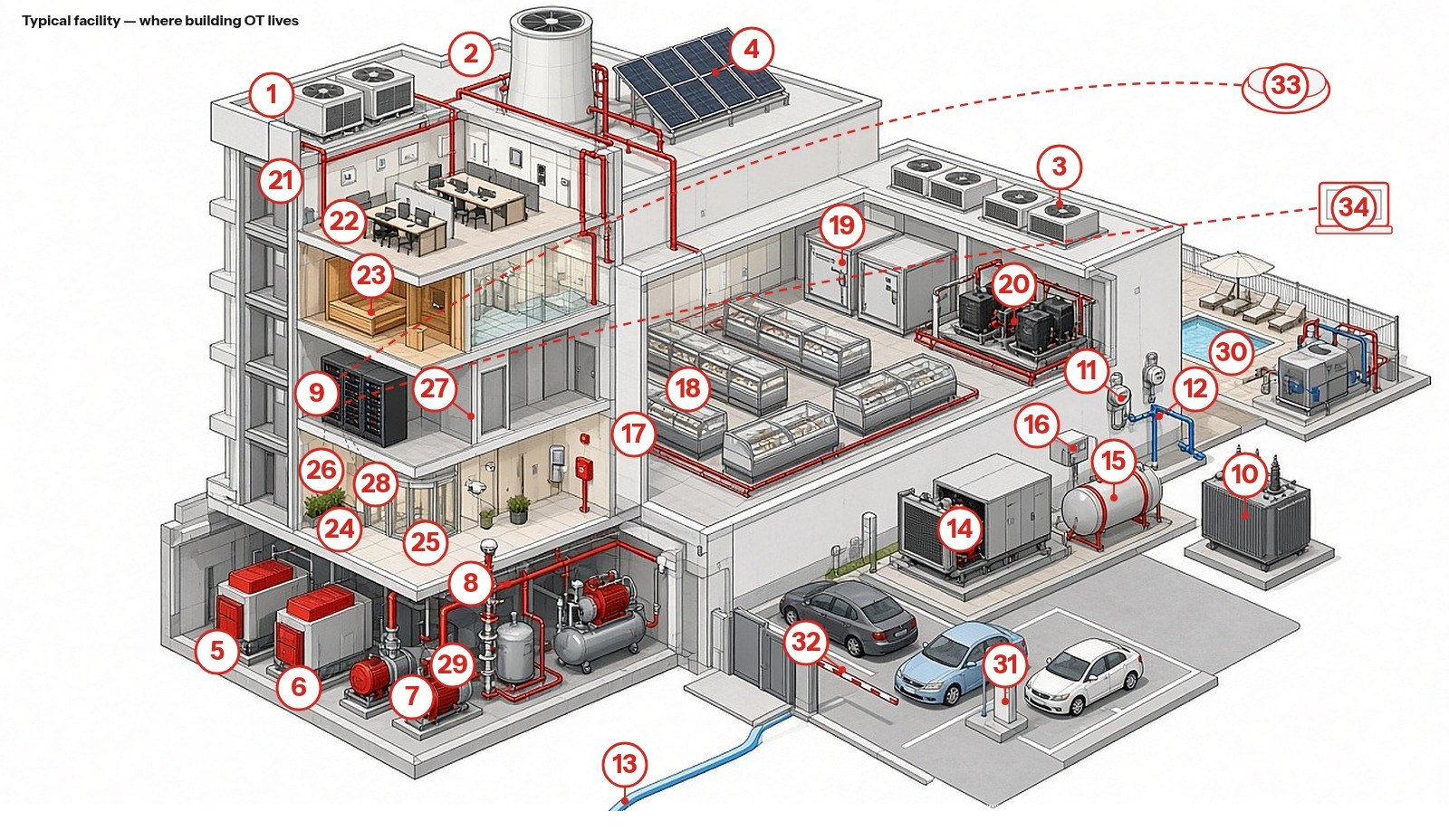
Zones: 1–4 rooftop · 5–12 mechanical · 13–19 utility/sales · 20–24 refrigeration · 25–28 life safety · 29–34 site/remote.

Building OT does not fail quietly into a help-desk ticket. It fails into product loss, equipment damage, and comfort or safety problems.
In the French supermarket case, compromised refrigeration controls forced extended defrost cycles. Dark Reading reported spoiled food, damaged equipment, some fires, and millions of euros in losses across about 700 stores, with later spread across Europe and into blood-bank refrigeration. The initial access vector remains unconfirmed; the reusable pattern is the exposed setup. [1]
Why these systems get missed. Facilities or refrigeration contractors often own them, outside IT security. Lifecycles run for years or decades. Firmware goes unsupported. Each site looks like “just a few controllers,” until the same pattern is running at hundreds of locations. [1]
Every entry is from a named public source. Supporting systems and contractor access keep showing up as the way in.
Stolen credentials from HVAC contractor Fazio Mechanical (billing/project-management link) — not an attack through Target’s BAS.
[3] Krebs on Security
DoS on building-automation heating and hot-water controls in two Finnish buildings until they were taken offline.
Internet-connected fish-tank sensors used as a path into a North American casino network.
[6] CNN / Darktrace
Cloud camera platform compromised; live and archived video exposed for a subset of customers.
Refrigeration controllers at ~700 French stores forced into long defrosts — spoilage, damage, millions of euros lost.
[1] Dark Reading, Nov. 6, 2026
Same pattern in ~10 more EU countries; three French blood-bank refrigeration hits stopped before plasma damage.
[1] Dark Reading, Nov. 6, 2026
Tell Red Tiger which stores, campuses, or facilities belong in scope. Plant-safe assessment. No shutdown.
From Red Tiger field assessments: these supporting systems belong in OT scope.
In many of our OT cybersecurity assessments, we still have to convince asset-owner clients to put building automation, HVAC, refrigeration, instrument air, and building controls in scope. They are easy to leave off the list because they sit under facilities or a contractor, not under the control room. That is a mistake.
When these systems fail, the process feels it. Losing instrument air can stop pneumatic valves and actuators. HVAC or cooling failures can overheat control rooms and server rooms. Refrigeration loss spoils product. The same systems often share networks or remote-access paths with the plant, and nobody on the security side owns them, so they become the overlooked way in.
We recommend including these systems in every OT assessment scope. Walk the perimeter down through the contractor paths and into the controllers that keep the site running, not only the PLCs that run the main process.
A plain comparison of the pattern Dark Reading described and the protect pattern Red Tiger puts in place at a site.
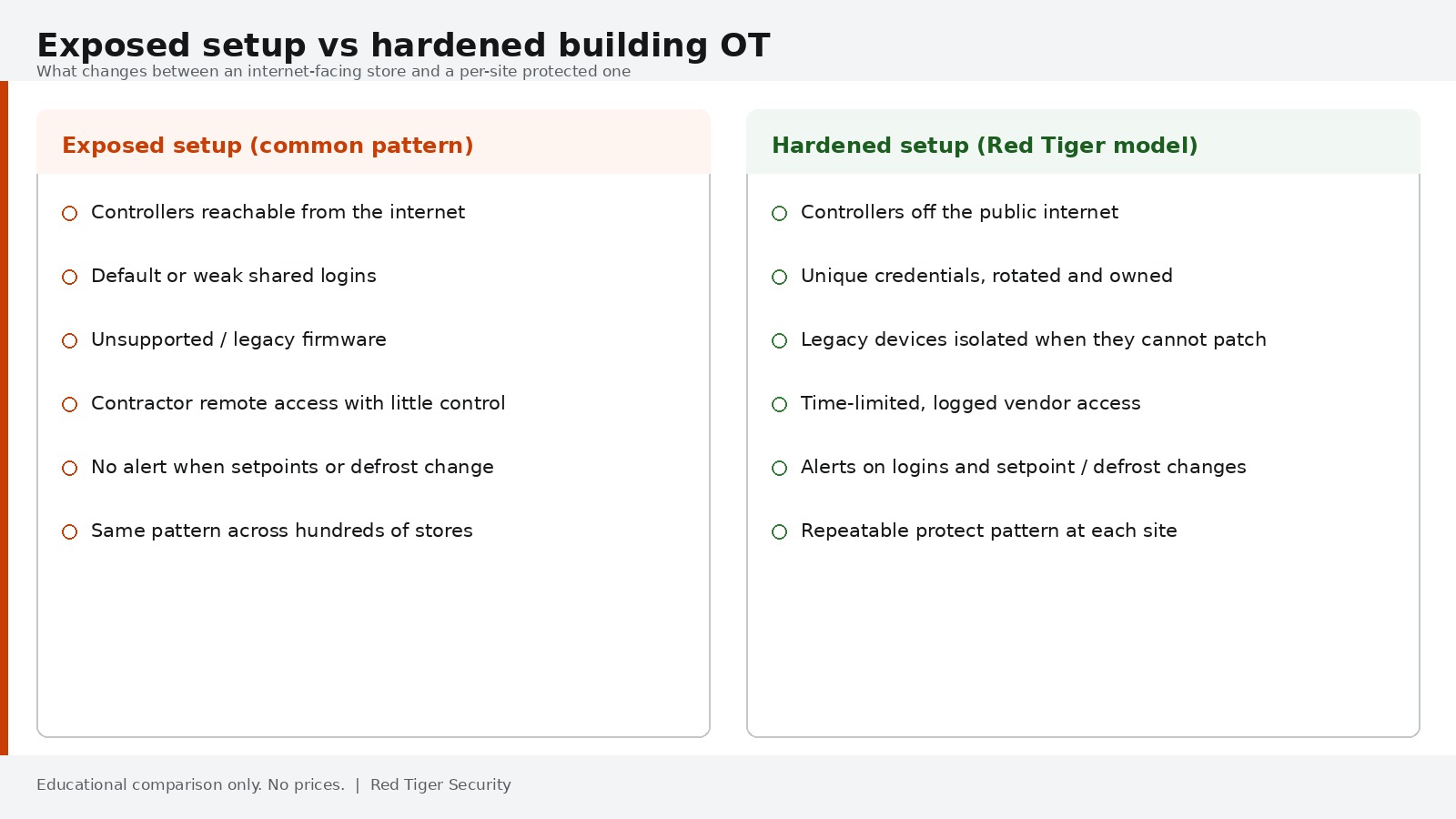
| Topic | Exposed setup | Hardened setup |
|---|---|---|
| Controller reachability | Web servers reachable from the internet | Controllers off the public internet |
| Logins | Default or weak shared credentials | Unique credentials, owned and rotated |
| Firmware | Unsupported legacy products still online | Legacy devices isolated when they cannot be patched |
| Vendor access | Open remote-maintenance paths across many stores | Time-limited, logged, controlled vendor access |
| Detection | No alert when setpoints or defrost change | Alerts on controller logins and setpoint / defrost changes |
| Scale | Same risky pattern at hundreds of sites | Repeatable protect pattern at each store or site |
Protect pattern: controllers, vendor remote access, OT firewall and network sensor, then 24x7 SOC. See How to get started.
List BAS, HVAC, refrigeration, instrument air, and building-control assets, including who maintains them and how they connect.
Take controller web interfaces off the public internet. Put a per-site firewall in front of the controls.
Replace default and shared logins. Own the credentials; do not leave them with a vendor alone.
Make remote maintenance time-limited, logged, and approved. Know which contractor can reach which site.
Alert on controller logins and on setpoint or defrost changes that do not match normal operations.
Isolate devices that cannot be patched. Add independent temperature alarms where product or patient material is at risk.
The same three-step model Red Tiger uses for water and other plant environments, applied to building automation system cybersecurity, HVAC cybersecurity, and retail refrigeration cybersecurity.
Then the team fixes what is hurting operations now. If you want Red Tiger to stay, a small firewall and sensor go in at the plant, the team watches those assets 24x7 with the Red Tiger SOC, and you get 24x7 MSP + Metrics and Reports.
For multi-site grocery and facilities portfolios, the protect pattern is designed to repeat store by store or site by site. Talk with the team about how that fits your footprint. No public price list is published on this page.
Start with a plant-safe assessment of the BAS, HVAC, refrigeration, and building controls that keep the site running.
Refrigeration and HVAC service contractors sit in the middle of this problem and can be part of the fix. Red Tiger works with contractors who want a clear, plant-safe way to harden the sites they maintain: inventory, remove internet exposure, control their own remote access, and leave the owner with monitoring that makes sense to facilities and security. If that is your business, ask about a partner conversation when you request an assessment.
Numbers match the bracketed citations on this page. Sources checked Nov. 8, 2026.
Common questions about BAS cybersecurity, BMS cybersecurity, HVAC hacking risk, and OT security for commercial buildings.
A building automation system (BAS/BMS) is the control layer for building management system security. It runs HVAC, boiler and chiller controls, lighting, and often interfaces to access control and CCTV, life safety systems, and generator and UPS monitoring. Those controllers speak BACnet, Modbus, LonWorks, KNX, and Niagara/Tridium — BACnet security included. That is OT: wrong setpoints change temperature, refrigeration, and safety in the physical world.
Yes. HVAC hacking and refrigeration controller security failures usually start with internet-reachable controllers, default passwords, unsupported firmware, or open vendor remote access. Recent cold storage / freezer cyberattack reporting in Europe followed that pattern on supermarket and blood-bank refrigeration — the same model shows up in U.S. grocery, retail, and cold chain sites.
In the Target HVAC breach, attackers used stolen network credentials from Target's HVAC contractor, Fazio Mechanical. That foothold was on the contractor's billing and project-management connection into Target's corporate network — not a path through the building automation system itself. It is still the case most facilities teams cite when they ask whether vendor remote access belongs in scope.
Yes, if the site runs building controls that can stop people getting comfortable air, keep product cold, or touch life safety. A facility OT assessment should cover BAS/BMS cybersecurity, HVAC cybersecurity, retail refrigeration cybersecurity, instrument air, and the building IoT/IIoT devices tied into those loops. Smart building cybersecurity is the same walk Red Tiger already does on plants: perimeter down to the field devices.
The work is plant-safe on live OT. The team inventories controllers, maps vendor remote access, and looks for internet exposure and weak credentials beside facilities and the HVAC or refrigeration contractor. Findings are mapped to NIST CSF and ISA/IEC 62443 so the board and the OT engineers share one language. Controllers are not taken offline for the assessment.
If you want Red Tiger to stay, a small OT firewall and network sensor go in at the site in front of the building controls. The team watches those assets 24x7 with the Red Tiger SOC, and you get OT managed security services (MSP) + Metrics and Reports on the cadence you set. Alerts cover controller logins and setpoint or defrost changes that matter to operations.
Yes. Building IoT/IIoT security is in scope when those devices sit on the same paths as the BAS: smart thermostats, wireless sensors, cameras, cloud gateways, and refrigeration or HVAC controllers that phone home. Access control and CCTV security paths that terminate at the BAS/BMS head-end are included in the same walk.
Start with a plant-safe assessment of the Building Automation Systems that keep the site running. Request an assessment on this page, or book a call. From there the team can harden the immediate need and, if you want Red Tiger to stay, put 24x7 SOC monitoring in place under the MSP close.
Tell Red Tiger about the stores, campuses, or facilities you want in scope. +1.877.387.7733 · info@redtigersecurity.com · or book a call.