November 25, 2026
← All advisories

Peninsula Energy Confirms Lance Cyber Incident Hit Plant and Wellfield Control Systems

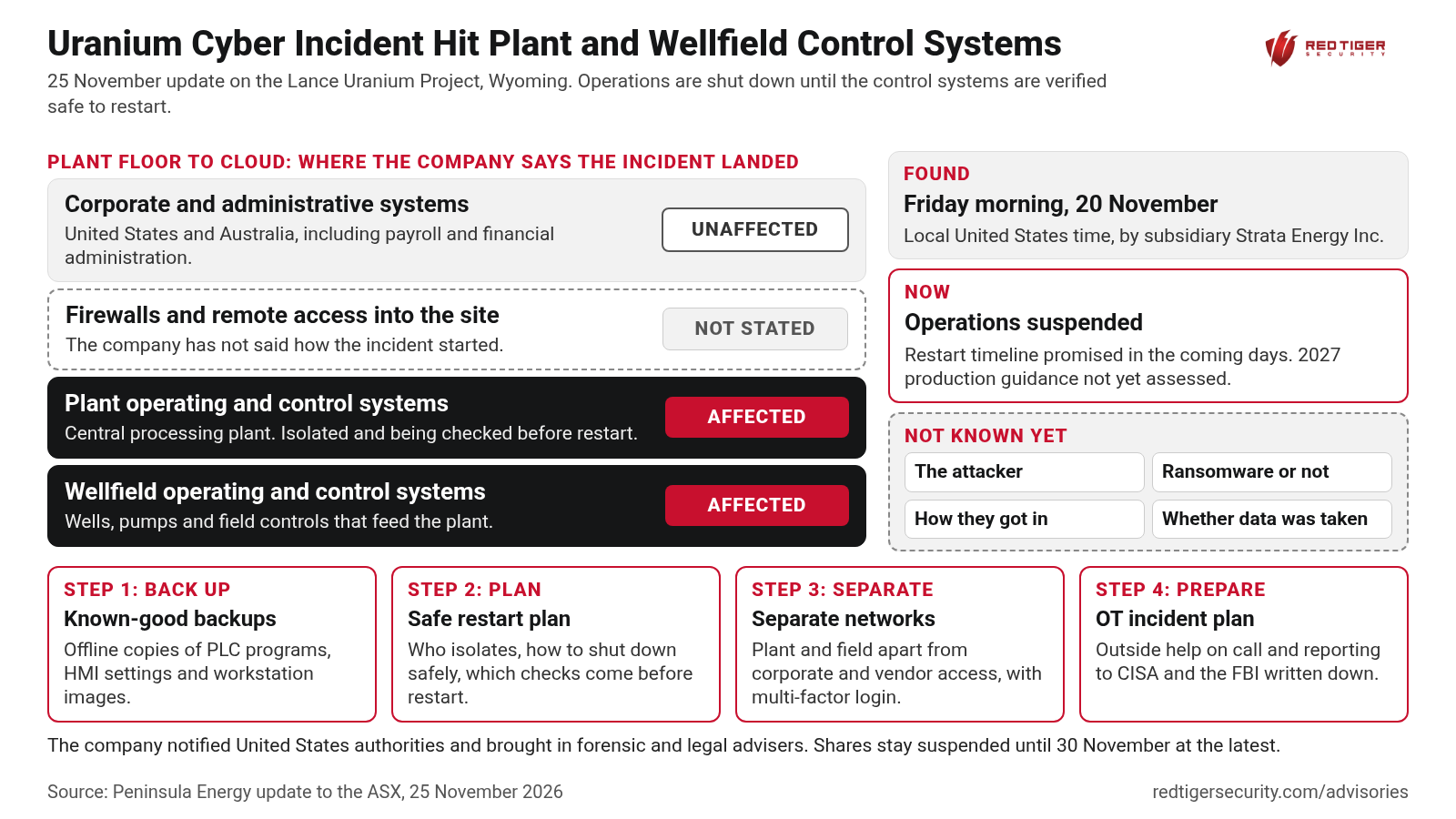
Red Tiger Security infographic: Uranium cyber incident hit plant and wellfield control systems. A plant floor to cloud cross-section of Peninsula Energy's Lance Uranium Project marks corporate and administrative systems, including payroll and finance, as unaffected; firewalls and remote access as not stated; and plant and wellfield operating and control systems as affected. Side cards: found the morning of Friday, 20 November, local United States time; operations suspended with a restart timeline promised in the coming days; not known yet: the attacker, ransomware, how they got in, and whether data was taken. Four steps: known-good offline backups, a safe restart plan, separate networks with multi-factor login, and an OT incident plan with reporting to CISA and the FBI.

Peninsula Energy Limited (ASX: PEN), the Australian uranium company, released an update on 25 November 2026 on the cyber security incident at its wholly owned Lance Uranium Project in Wyoming, in the United States. The update fills in the biggest gap from the company's first announcement on 23 November. The company now says the incident affected "the plant and wellfield operating and control systems" at Lance. Lance is an in situ recovery (ISR) uranium project, where a solution is pumped through wells to dissolve uranium underground and brought back to the surface for processing at a central plant.

Our 24 November advisory noted that the company had not said which systems were involved. This update confirms that the operating and control systems for the plant and the wellfield were affected. The earlier advisory is here: https://www.redtigersecurity.com/advisory/peninsula-energy-lance-uranium-cyber-incident

What is new in the 25 November update

  1. Strata Energy Inc., Peninsula's wholly owned subsidiary, identified the incident on the morning of Friday, 20 November 2026, local United States time.
  2. The company activated its incident response procedures and took precautionary measures, including a temporary shutdown of operations at Lance and isolation of the affected systems. It says its priorities are the safety of its employees, securing its operating systems and restoring operations in a safe and controlled manner.
  3. Based on investigations to date, the company says the incident appears to be confined to the plant and wellfield operating and control systems. Its corporate and administrative systems in the United States and Australia, including payroll and financial administration, remain unaffected.
  4. The company notified relevant authorities in the United States and brought in specialist external cyber security consultants, forensic advisers and legal advisers. The investigation is ongoing and is also looking at potential data impacts.
  5. A recovery program is assessing the integrity of the affected systems, putting security and restoration measures in place, and verifying that the plant operating and control systems can be safely returned to service. Operations will stay suspended until that work is complete, and the company says it will give an update on the expected restart timeline in the coming days.
  6. The company says it cannot yet assess whether the incident will materially affect its production guidance for calendar year 2027, and will reassess once operations resume. It has asked for a voluntary suspension of its shares until the start of trading on Monday, 30 November 2026, or until it announces the resumption of operations, whichever comes first.

What is still not known

The company has not named an attacker, said whether ransomware was involved, explained how the attackers got in, or said which specific control system components were affected. It has not said whether any data was taken, and it has not given a restart date.

What this means for operational technology owners

This is a confirmed incident in the operational technology (OT) systems of a working United States industrial site, and it has stopped production. The office systems, including payroll and finance, were not affected, but the part of the business that makes money is down. The update also shows why restarting takes time. Before a plant like this can run again, someone has to prove that the controllers, operator screens and configurations are the ones that should be there. That goes much faster when you already have offline, known-good copies to compare against and a tested plan for a safe shutdown and restart.

Where this shows up, plant floor to cloud

At an ISR site, the wellfield includes wells, header houses, pumps, flow meters and the controllers that run them, often linked back to the plant over radio or fiber. The central processing plant has its own programmable logic controllers (PLCs), human-machine interface (HMI) operator screens, a historian that records process data, and engineering workstations. The company's words, "plant and wellfield operating and control systems," point to these layers, although it has not named specific components. Above them sit the firewalls and remote access paths that connect the site to vendors and to head office, and above those the corporate network and cloud services, which the company says were not affected.

What to do now

  1. Keep offline, tested backups and a known-good record of PLC programs, HMI and supervisory control and data acquisition (SCADA) configurations, and engineering workstation images, so you can verify integrity and restore in days rather than weeks.
  2. Write down and practice a safe shutdown and restart plan: who can decide to isolate the control systems, how to bring the plant and the field down safely, and which checks must pass before restart.
  3. Separate plant and field control networks from corporate IT and from vendor remote access, and review every remote access path into remote sites, with multi-factor authentication (MFA) and logging on each one.
  4. Have an OT incident response plan with outside help already on call and your reporting duties written down. For United States critical infrastructure, that includes reporting to the Cybersecurity and Infrastructure Security Agency (CISA) and the Federal Bureau of Investigation (FBI).

Red Tiger can help you prepare before an incident and recover safely after one. During our plant-safe onsite assessments, our team walks the system from the perimeter through the demilitarized zone (DMZ) and control room down to the field devices, including remote sites and vendor connections. We can then help remediate and harden what we find, help you build and practice an OT incident response and recovery plan, and install a firewall and sensor at the site, connect them to the Red Tiger 24x7 security operations center (SOC), and monitor the site for ongoing detection and response, with regular metrics and reports. Our team has completed more than 500 assessments and trained more than 4,500 people.

We are here to help, so check out our resources online at www.redtigersecurity.com and book a follow-up call with our team if you have any questions: https://calendly.com/jonathanpollet/30min

Source: Peninsula Energy Limited, Peninsula Provides Update on Lance Cyber Security Incident and Recovery Program, 25 November 2026: https://announcements.asx.com.au/asxpdf/20261125/pdf/07713j5lcmq88h.pdf

← All advisories

Cite this advisory: Red Tiger Security, "Peninsula Energy Confirms Lance Cyber Incident Hit Plant and Wellfield Control Systems", November 25, 2026, https://www.redtigersecurity.com/advisory/peninsula-energy-lance-control-systems-update

Read the original source →

We are here to help.

Check out our resources and book a follow-up call with our team.
+1.877.387.7733