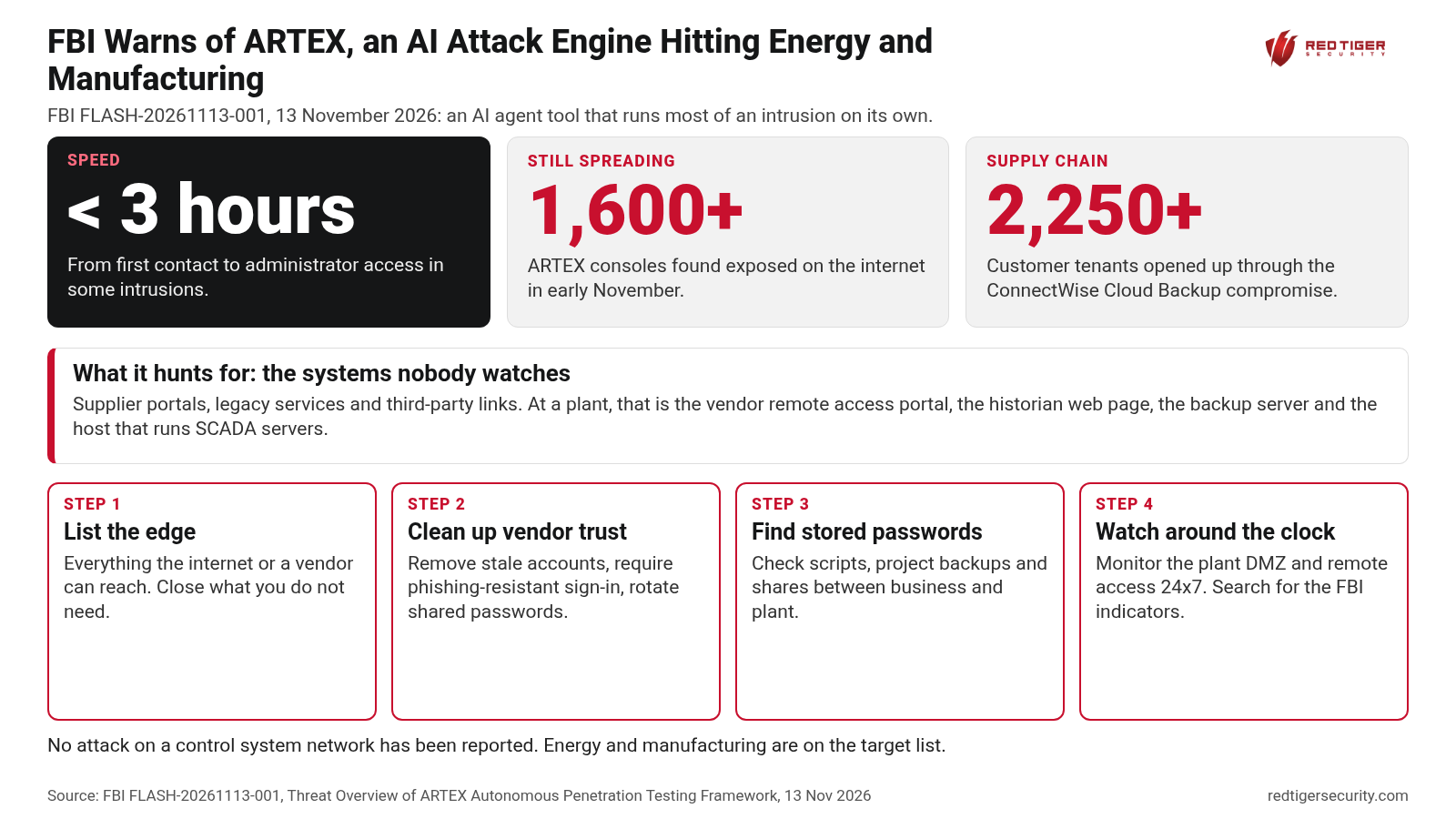
The Federal Bureau of Investigation (FBI) released a FLASH alert on 13 November 2026 (FLASH-20261113-001) about ARTEX, an open-source "autonomous penetration testing" tool that a variety of attackers have turned into an attack engine. ARTEX uses artificial intelligence (AI) agents, powered by large language models (LLMs), the same kind of model behind popular chatbots, to run most of an intrusion on its own, from scanning a target to stealing data. The FBI says a variety of attackers have used it since at least August 2026 against organizations around the world, and energy and manufacturing are on its list of targeted sectors along with finance, government, defense, semiconductors, healthcare, telecommunications and legal firms. The FBI does not report an attack on an operational technology (OT) network, but the systems ARTEX goes after are the same ones that sit around most plants.
ARTEX takes a goal written in plain English and turns it into commands carried out by a team of AI agents, with very little human involvement after that. The FBI says some intrusions went from first contact to privileged administrator access in under three hours. The tool lets attackers with little skill run complex campaigns against many targets at once. Campaigns the FBI cites include the theft of personal information on about 67,000 people from South Korean financial institutions, and the ConnectWise Cloud Backup supply chain compromise that Microsoft reported in October, which opened access to more than 2,250 customer tenants (separate cloud accounts belonging to different customer organizations).
What is new is the government confirmation that this is spreading, not fading. The original developer pulled the code from GitHub on 8 October 2026, yet the FBI says ARTEX keeps circulating through copies, modified versions and a paid "ARTEX PRO" edition, and researchers counted more than 1,600 ARTEX control consoles exposed on the internet in early November. Microsoft-tracked activity cited in the alert was still active as of 6 November.
The FBI says ARTEX is good at finding the systems that get less attention than the main company website: partner and supplier portals, employee apps, legacy services and third-party connections. It also maps trust between companies, so a weaker vendor becomes a path into its customers. The alert lists indicators of compromise (IOCs), the addresses and traces defenders can search for, and we point readers to the FBI document for that list rather than repeating it here.
Red Tiger's view is that the "overlooked systems" in this alert describe the edge of a typical plant very well. Think of the vendor remote access portal an integrator uses to reach the jump server, the historian web page published for corporate reporting, the backup server and virtualization host that run SCADA (supervisory control and data acquisition) servers, and the cloud tenant where a managed service provider keeps its tools. Each one is a bridge from the internet or a supplier into the plant demilitarized zone (DMZ), the buffer network in front of the control system. An attack engine that never sleeps will find the forgotten one first. And when an intrusion can reach administrator rights in less than three hours, a weekly log review is too slow. Someone has to be watching around the clock, whether that is your own team or a security operations center (SOC).
Red Tiger can help with this beyond the assessment itself. We fix and harden the weaknesses we find, and we can install a firewall and sensor at the site, connect them to the Red Tiger 24x7 SOC, and monitor the plant for ongoing detection and response, with regular metrics and reports.
We are here to help, so check out our resources online at www.redtigersecurity.com and book a follow-up call with our team if you have any questions: https://calendly.com/jonathanpollet/30min
Source: FBI FLASH-20261113-001, Threat Overview of ARTEX Autonomous Penetration Testing Framework, 13 November 2026: https://www.ic3.gov/CSA/2026/261113.pdf
Check out our resources and book a follow-up call with our team.