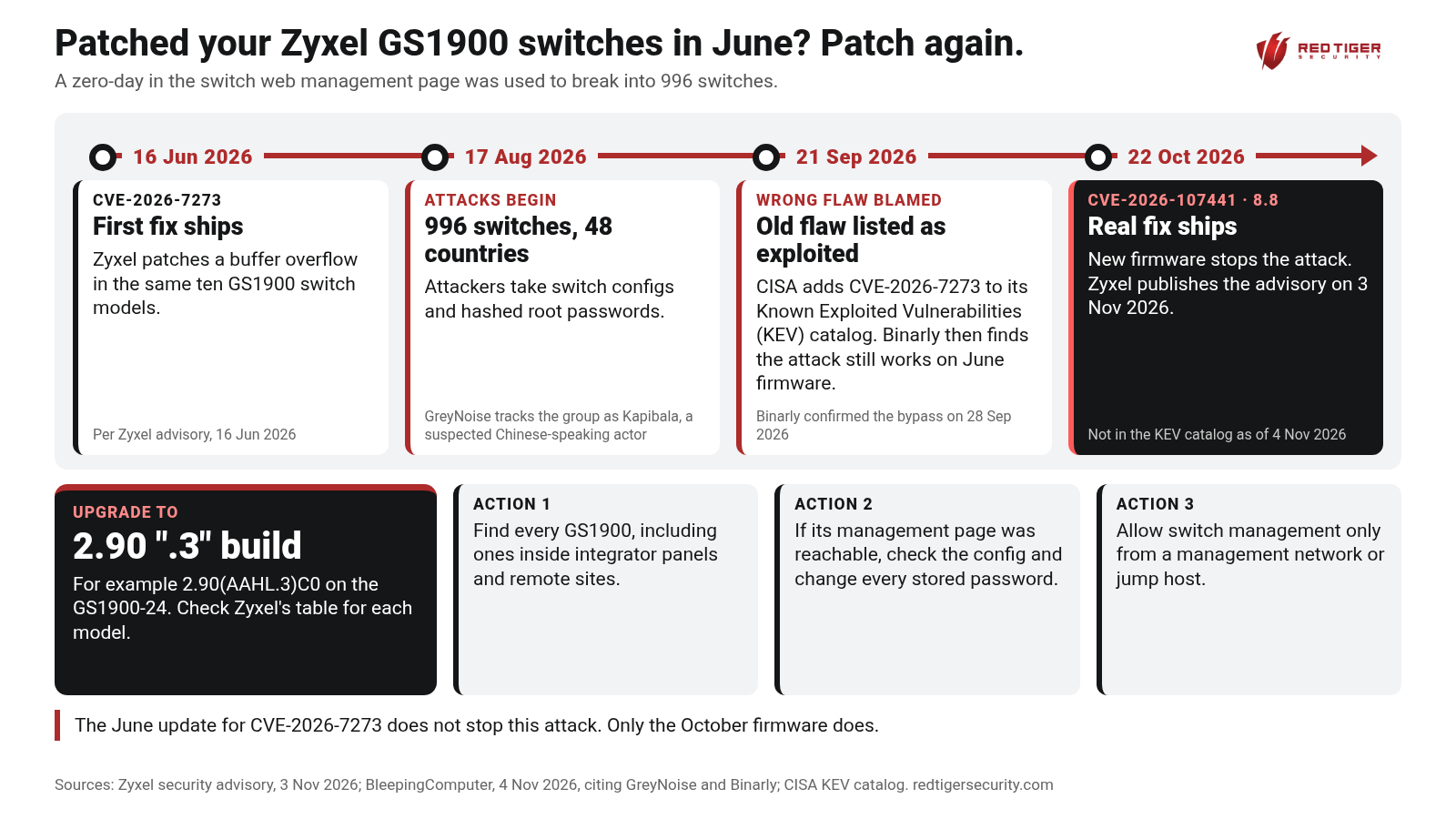
Zyxel has fixed a zero-day flaw in its GS1900 series managed network switches that attackers used to break into nearly 1,000 switches around the world and steal their configuration files and passwords. A zero-day is a flaw that attackers use before the vendor has a fix. The important detail for owners is that many sites already thought they were protected. The attacks were first blamed on an older flaw that Zyxel had patched in June, but researchers later showed that the attack still worked on switches running that June update.
On 3 November 2026, Zyxel published a security advisory for CVE-2026-107441, an out-of-bounds write flaw in the program behind the switch's web management page. An out-of-bounds write means the software writes data past the end of the memory set aside for it, which can let an attacker run their own commands. Zyxel says an attacker on the local network, with no login, could use a specially crafted web request to run operating system commands on the switch. Zyxel rates it 8.8 out of 10, High, on the Common Vulnerability Scoring System (CVSS).
Ten models are affected: GS1900-8, GS1900-8HP, GS1900-10HP, GS1900-16, GS1900-24, GS1900-24E, GS1900-24EP, GS1900-24HPv2, GS1900-48 and GS1900-48HPv2. Every affected model needs firmware version 2.90 build ".3" or later, for example 2.90(AAHH.3)C0 for the GS1900-8 and 2.90(AAHL.3)C0 for the GS1900-24. Zyxel's advisory lists the exact fixed version for each model. BleepingComputer reports that the fixed firmware was released on 22 October.
BleepingComputer reports the following sequence, based on findings from the security firms GreyNoise and Binarly:
GreyNoise links Kapibala to a wider campaign called Red Heron, which the security firm Acronis previously reported was exploiting a flaw in Gitea, a self-hosted code repository service. As of 4 November 2026, CVE-2026-107441 itself is not in the KEV catalog, but the attacks that prompted it are the same ones CISA already listed under the older number.
Small managed switches like the GS1900 are common in places that do not always get the attention of the main network: pump stations, lift stations, water plants, remote substations, packaging lines and control panels put together by integrators. They are often set up once and then left alone for years. A switch that an attacker controls can copy traffic, change virtual local area networks (VLANs, the settings that keep the control network apart from everything else) or be used as a quiet foothold to reach programmable logic controllers (PLCs) and human-machine interfaces (HMIs) on the same network. Because the attackers took configuration files and password hashes, a switch that was compromised and then patched may still have exposed passwords that are reused on other switches or devices.
On the plant floor, GS1900 switches connect controllers, drives, operator panels and cameras inside cabinets and remote sites. In the control room and supervisory network, they may link supervisory control and data acquisition (SCADA) servers, historians and engineering workstations. At the business edge and in branch offices, the same models connect office networks, and their web management page is sometimes reachable from the business network or even the internet, which is where an attacker reaches it first.
Red Tiger Security has completed 500+ plant-safe operational technology (OT) assessments and trained 4,500+ engineers and operators. Our team can help you build an inventory of the network gear inside your plants and remote sites, find management interfaces that are exposed where they should not be, and set up 24x7 monitoring that flags configuration changes on your switches.
We are here to help, so check out our resources online at www.redtigersecurity.com and book a follow-up call with our team if you have any questions: https://calendly.com/jonathanpollet/30min
Zyxel, "Zyxel security advisory for out-of-bounds write vulnerability in GS1900 series switches," 3 November 2026: https://www.zyxel.com/global/en/support/security-advisories/zyxel-security-advisory-for-out-of-bounds-write-vulnerability-in-gs1900-series-switches-11-03-2026
BleepingComputer, "Zyxel fixes zero-day exploited to hack nearly 1,000 network switches," 4 November 2026: https://www.bleepingcomputer.com/news/security/zyxel-fixes-zero-day-exploited-to-hack-nearly-1-000-network-switches/
Zyxel, security advisory for CVE-2026-7273 in GS1900 series switches, 16 June 2026: https://www.zyxel.com/global/en/support/security-advisories/zyxel-security-advisory-for-stack-based-buffer-overflow-vulnerability-in-gs1900-series-switches-06-16-2026
Binarly, research on CVE-2026-107441 (supporting): http://www.binarly.io/blog/zyxel-gs1900-rce-cve-2026-107441
CISA Known Exploited Vulnerabilities catalog: https://www.cisa.gov/known-exploited-vulnerabilities-catalog
Check out our resources and book a follow-up call with our team.