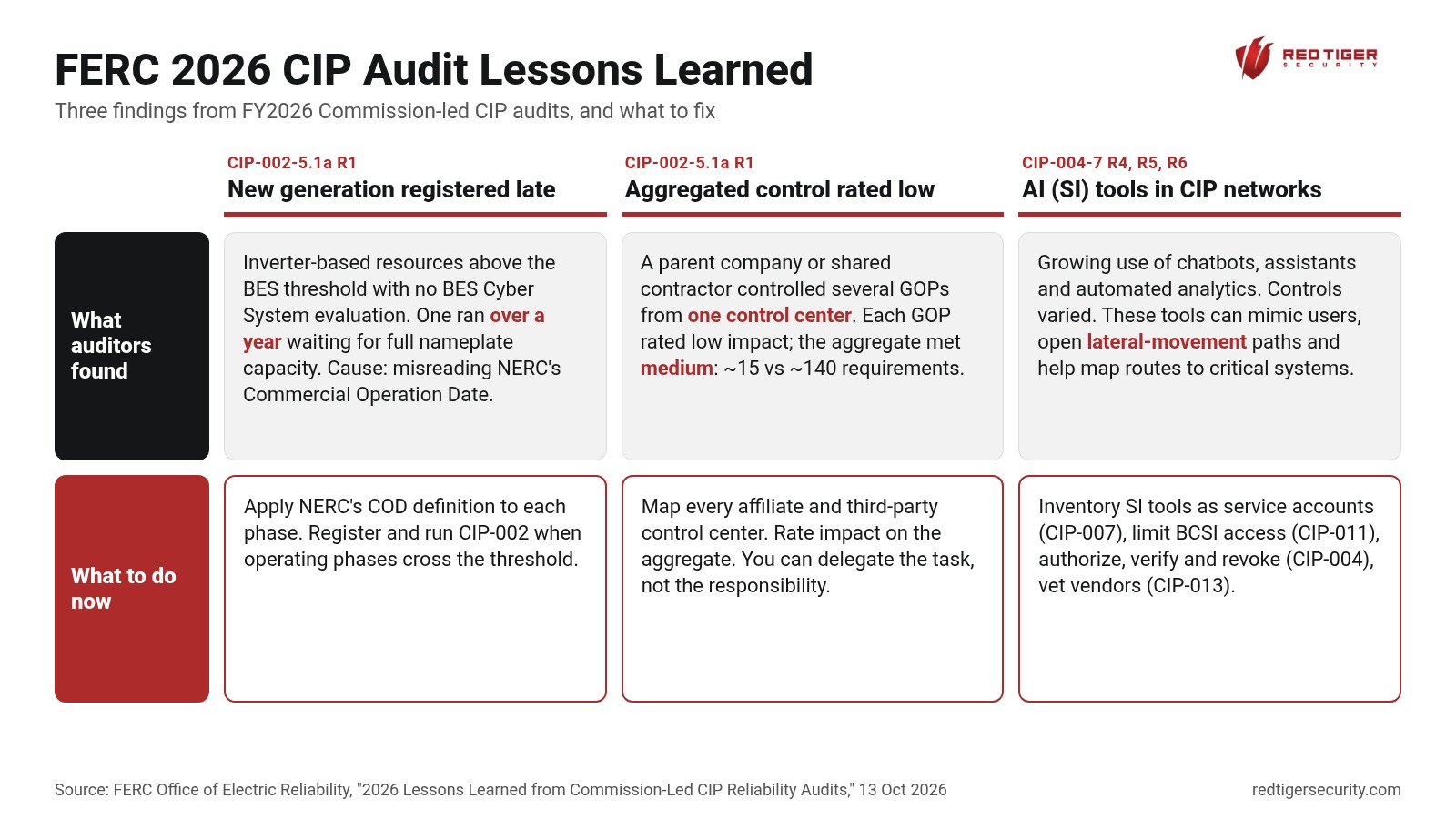
FERC staff released its 2026 lessons learned from Commission-led CIP audits, and all three findings come back to the same question every utility has to answer correctly: what are your BES Cyber Systems, and who can reach them?
On 13 October, FERC's Office of Electric Reliability, Division of Cyber Security published "2026 Lessons Learned from Commission-Led CIP Reliability Audits," covering the FY2026 audits run with NERC and Regional Entity staff, including on-site field inspections. Staff found most entities' processes met the CIP Reliability Standards, but potential noncompliance and security risks remained in three areas.
1. Late registration of new generation (CIP-002-5.1a R1). Staff found inverter-based resources synchronized to the BES and producing above the BES threshold whose cyber systems had not been identified and categorized. One entity ran over the threshold for more than a year while it waited to finish all phases of its interconnection queue. The cause was a misreading of NERC's Commercial Operation Date. Registration and CIP-002 evaluation are due when the operating phases exceed the threshold, not at full nameplate capacity.
2. Aggregated control that was rated low (CIP-002-5.1a R1). In two cases an unregistered parent company or a shared third-party contractor monitored and controlled several GOPs' generation from one control center. Each GOP rated its own systems low impact, but the aggregate met the medium impact criteria. According to the report, that is the difference between roughly 15 mostly plan-based requirements and roughly 140 requirements and sub-requirements. FERC also notes that a GOP can delegate the task but not the responsibility.
3. AI tools inside the CIP-networked environment (CIP-004-7 R4, R5, R6). Staff saw growing use of what the report calls super intelligence (SI) tools, such as chatbots, assistants and automated analytics. Most entities applied appropriate controls, but approaches varied. Access through these tools has to be authorized, periodically verified and revoked on time like any user's. FERC warns that these tools can mimic user behavior, open lateral-movement paths, and help adversaries map the environment toward critical systems.
Where this shows up, from the plant floor to the cloud:
• Enterprise and cloud: AI assistants and vendor-hosted SI features with reach into BES Cyber System Information.
• ESP and EACMS: communications from SI tools that leave the CIP-005 electronic security perimeter.
• Generation control center: one parent or contractor control room monitoring and controlling many sites.
• Field and plant: inverter-based resources running above the threshold before anyone has rated their cyber systems.
What the Red Tiger team recommends now:
1. Re-check registration timing. Apply NERC's COD definition to every phased or inverter-based project, and run CIP-002 when the operating phases cross the threshold.
2. Rate by aggregation. Map every affiliate and third-party control center with monitoring or control over your generation resources, and rate impact on the aggregate, not site by site.
3. Treat AI tools as users. Inventory SI tools as generic service accounts under CIP-007, change default passwords, limit BCSI access under CIP-011, and authorize, review and revoke their access under CIP-004.
4. Put SI in the supply chain plan. Assess SI features from vendors under your CIP-013 plan, and use a framework such as NIST AI RMF 1.0.
We are here to help, so check out our resources online at www.redtigersecurity.com and book a follow-up call with our team if you have any questions: https://calendly.com/jonathanpollet/30min
FERC report: https://www.ferc.gov/sites/default/files/2026-10/26_Lessons%20Learned_1013.pdf
FERC news release: https://www.ferc.gov/news-events/news/ferc-staff-report-offers-lessons-learned-2026-cip-audits
Check out our resources and book a follow-up call with our team.