A group of maritime and cybersecurity organizations has launched Blue Initiative, a free public database that lists the software and hardware vulnerabilities most likely to matter on ships, in ports, on offshore facilities and in the shore systems a fleet depends on. SecurityWeek reported the launch on 27 October 2026. For port operators, terminal operators and vessel owners working toward the United States Coast Guard (USCG) cybersecurity rule under the Maritime Transportation Security Act (MTSA), it is a useful new filter for a problem the Red Tiger Security team sees on almost every maritime assessment: too many vulnerability notices and no easy way to tell which ones touch the equipment actually on board or on the terminal.
What it is:
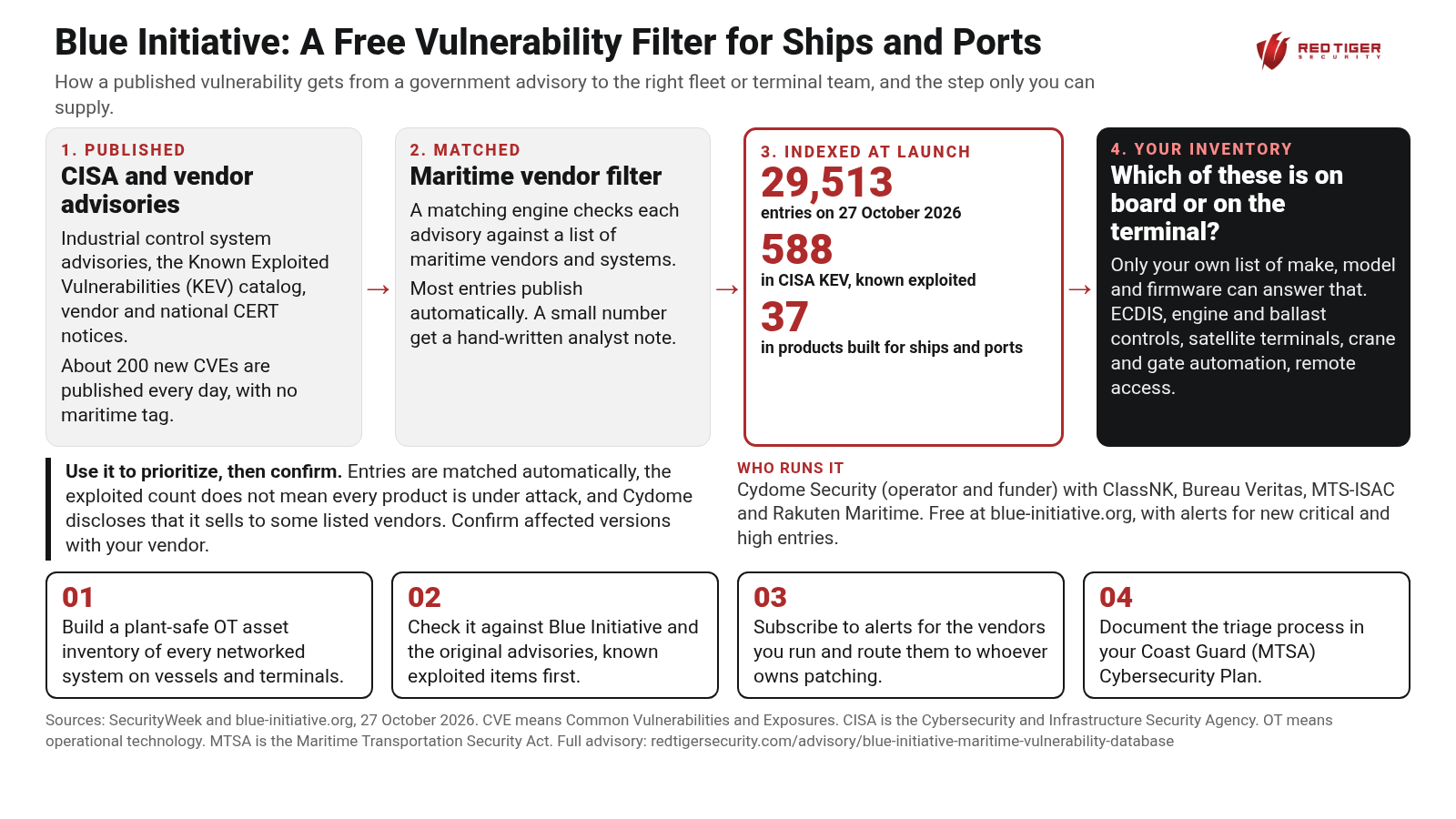
Blue Initiative is run and funded by Cydome Security, a maritime cybersecurity company, working with Japan's classification society ClassNK, the inspection and certification firm Bureau Veritas, the Maritime Transportation System Information Sharing and Analysis Center (MTS-ISAC) and Rakuten Maritime. A vulnerability is a published weakness in a product, usually tracked with a Common Vulnerabilities and Exposures (CVE) number. The national vulnerability databases do not tag entries as maritime, so a fleet manager has to work out on their own which of the 200 or so new CVEs published each day apply to their navigation, cargo, engine room or terminal systems.
According to the project and SecurityWeek, the database held nearly 30,000 entries at launch (29,513 on the Blue Initiative home page on 27 October), including about 2,000 rated critical, meaning a severity score of 9.0 to 10.0 out of 10, and 588 listed in the Known Exploited Vulnerabilities (KEV) catalog kept by the Cybersecurity and Infrastructure Security Agency (CISA), meaning attackers are known to have used them. Thirty-seven entries affect products built specifically for ships and ports. Users can search, filter by vendor or shipboard system, and subscribe to alerts for new critical and high-severity entries. The site hosts no exploit code.
What to keep in mind:
The project is open about how it works. Most entries are matched automatically from CISA industrial control system (ICS) advisories and the KEV catalog using a list of maritime vendors, and they are published without a person reviewing each one. Only a small number carry a hand-written analyst note. The aggregate exploited count also does not mean every listed product is under attack. Blue Initiative also discloses that Cydome sells products to some of the vendors and operators it lists. That makes it a good starting point for triage, not a replacement for your own asset inventory or your vendor's guidance.
Where it shows up, plant floor to cloud:
On a vessel, the relevant systems include the Electronic Chart Display and Information System (ECDIS), engine and ballast water controls, satellite communications terminals and the onboard network that ties them together. On a terminal, it is the crane and gate automation, the terminal operating system, building and access controls, and the remote access paths that vendors use to support them. On shore, it is the fleet management and cloud services that pull data off the ship. A single database that maps vulnerabilities to these systems helps connect each layer back to a named product.
What maritime owners should do now:
With 500+ assessments across critical infrastructure, including ports, terminals and vessels, the Red Tiger Security team helps maritime owners build plant-safe asset inventories, prioritize vulnerabilities against what is really installed, and document the results for Coast Guard compliance.
We are here to help, so check out our resources online at www.redtigersecurity.com and book a follow-up call with our team if you have any questions: https://calendly.com/jonathanpollet/30min
Source: https://www.securityweek.com/maritime-coalition-launches-free-vulnerability-database-for-ship-and-port-systems/
Check out our resources and book a follow-up call with our team.