Two new studies show how fast AI models are learning to plan attacks on industrial control systems, and both point back to the same OT basics.
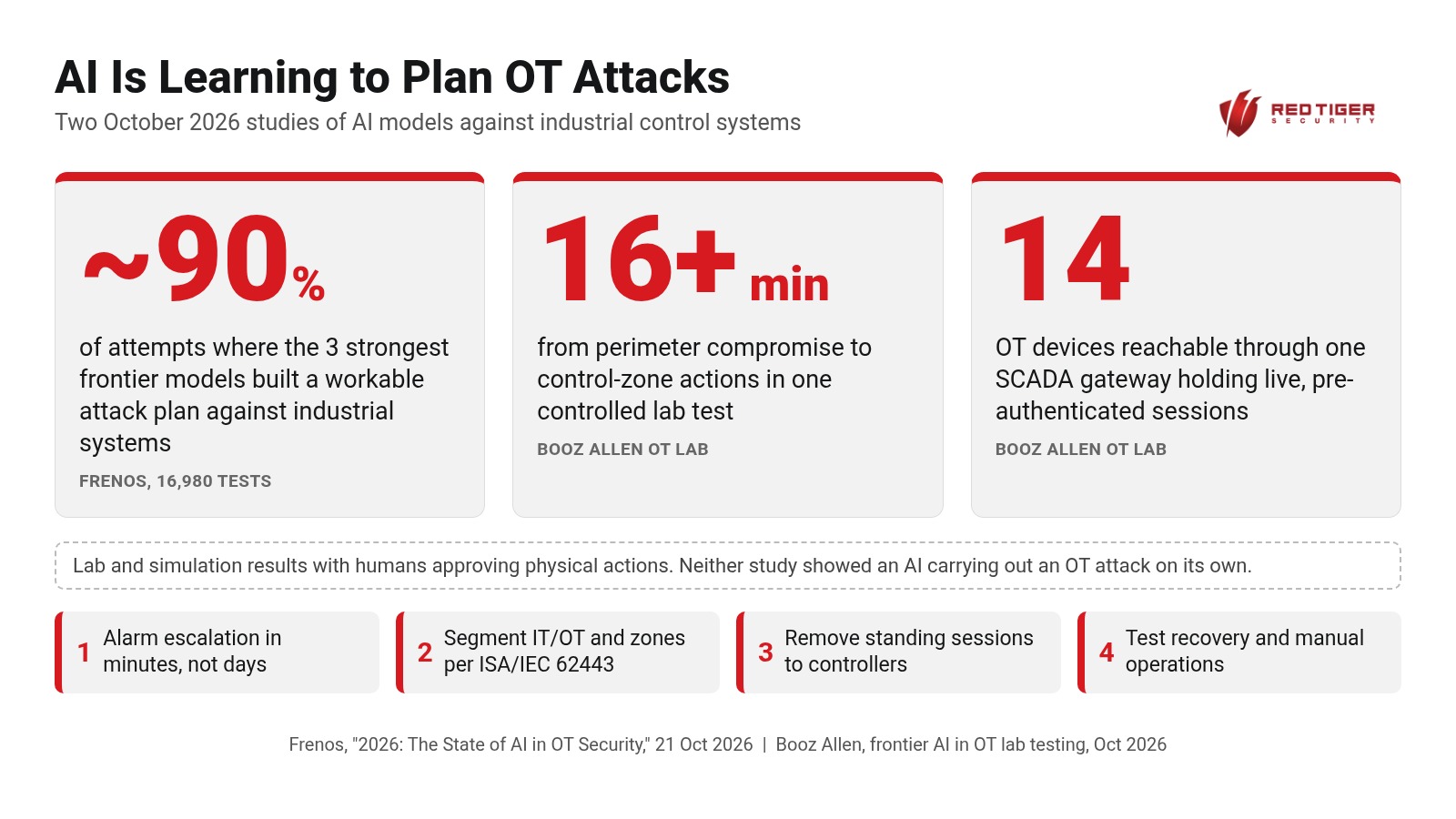
On 21 October, Frenos published "2026: The State of AI in OT Security." Across 16,980 tests run from October 2025 through September 2026, the three strongest frontier models built workable attack plans against industrial systems in roughly 90% of attempts (89.5% to 92.9%). The best foreign open-weight model passed 36.2% of the time and the best US open-weight model 5.2%. Frenos is clear that these were planning and simulation tests with supplied facts. The models sometimes skipped steps or assumed access they did not have, and autonomous OT attacks were not demonstrated.
Earlier this month, Booz Allen reported on eight controlled scenarios in its isolated, multi-vendor OT lab modeled on a manufacturing plant. The models achieved all eight objectives. In one test they went from perimeter compromise to control-zone actions in just over 16 minutes, and in another they identified and moved a robotic arm within minutes. Humans approved every exploit and every physical action. Firewalls, segmentation, endpoint protection and local-control settings slowed or stopped some actions, but no single safeguard stopped them every time.
Where this shows up, from the plant floor to the cloud:
• Enterprise and cloud: stolen credentials and exposed VPNs are still the front door.
• DMZ and remote access: jump hosts and vendor access paths are where an attacker crosses into OT.
• Control room and Level 3: SCADA servers, engineering workstations and gateways that hold live sessions to many controllers. Booz Allen found one SCADA gateway with pre-authenticated sessions to 14 OT devices.
• Field devices: PLCs, drives and robots that will act on a valid command.
What the Red Tiger team recommends now:
1. Assume the response window is minutes, not days. Tune OT monitoring and alarm escalation so a perimeter-to-control-zone move gets a human's attention right away.
2. Layer the defenses. Segment IT from OT and zones inside OT per ISA/IEC 62443, and lock down remote access with MFA and time-boxed vendor sessions.
3. Remove standing access. Find gateways and engineering stations that keep pre-authenticated sessions to controllers, and use key switches and local-control settings on critical equipment.
4. Test recovery. Exercise your incident response and manual operations plans with operations in the room, not just IT.
We are here to help, so check out our resources online at www.redtigersecurity.com and book a follow-up call with our team if you have any questions: https://calendly.com/jonathanpollet/30min
Frenos report: https://frenos.io/2026-ai-ot-report
Booz Allen: https://www.boozallen.com/insights/cyber/frontier-si-reaches-ot-systems.html
Check out our resources and book a follow-up call with our team.